When you use Sarbacane, it is important to take care of your database.
Both to ensure good deliverability, but also to assess as accurately as possible the performance of your communications.
To do this, depending on your sending frequency, we recommend that you carry out a clean-up of your inactive contacts.
Indeed, the more your recipients open your communications, the better your reputation will be, thereby increasing your chances of reaching the main inbox.
By removing your inactive contacts who have not opened your communications for a long time, you will obtain more relevant statistics. In fact, if you keep non-openers for years, this means that as soon as you send your communications, you are starting out with a base of inactive contacts.
To identify your inactive contacts over a defined period, you can go to the “Statistics” section of Campaigns and select all the campaigns to review:
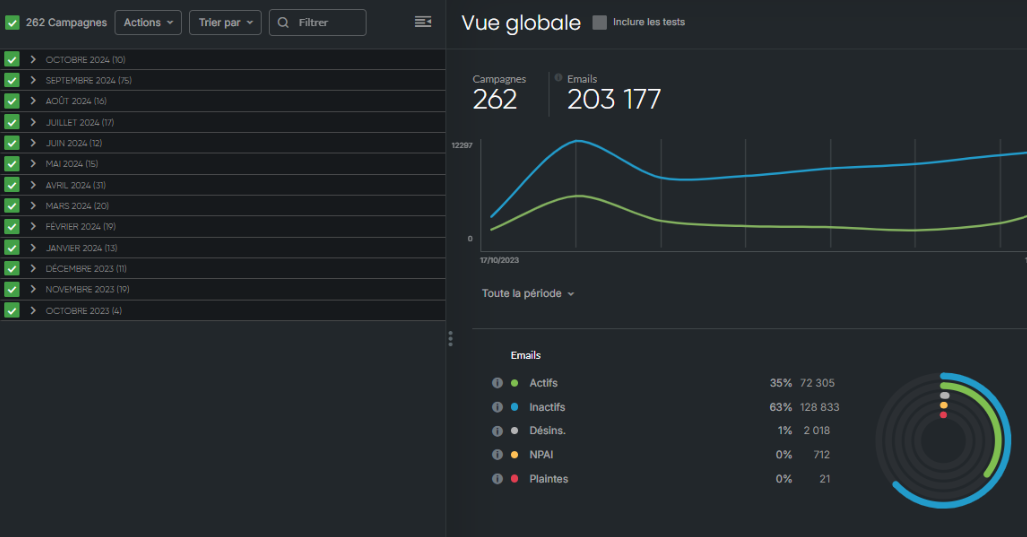
Here, the number of inactive contacts is 128,833 for a rolling year. Please note that this figure currently takes into account cumulative inactive contacts and is unfiltered, so it will be lower later on.
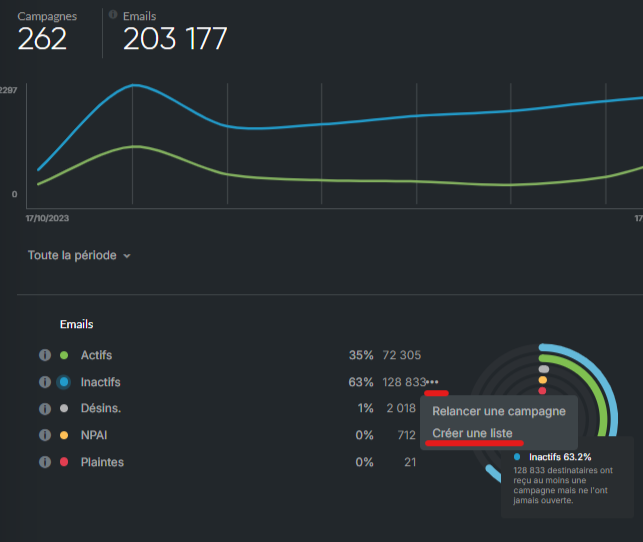
When you click on “Create a list”, criteria are displayed to allow you to refine your selection of inactive contacts. Once these have been defined, you can click on “run the count”.
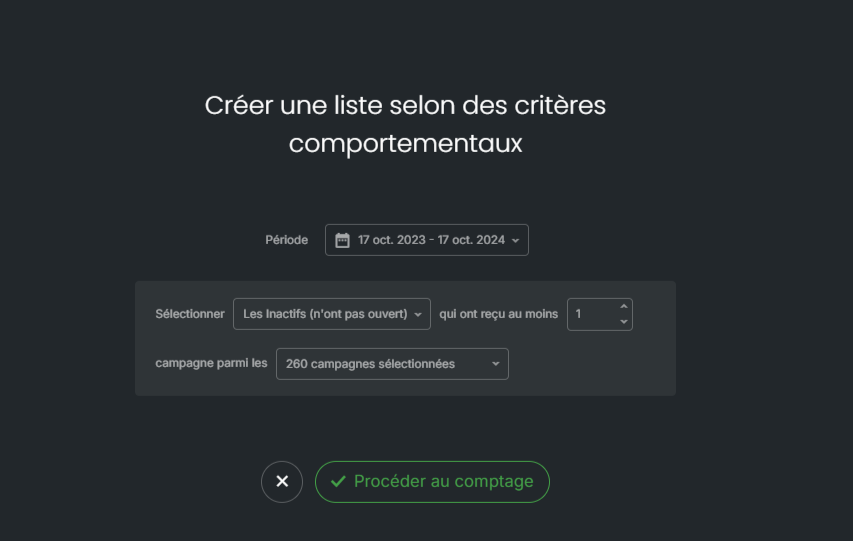
Here, the software then calculates the number of inactive contacts over a rolling year who have received at least one campaign but have never opened your communications.
By clicking on “Next”, your contact list will be created, and you will be able to use it in several ways:
either you exclude these people from your recipients, because you consider that if they have not opened your message for a year, it is no longer worthwhile to contact them.
or you can create what is called a re-engagement campaign, enabling you to rekindle the interest of your subscribers or customers who have become inactive. The objective is to re-establish contact and reactivate these users by encouraging them to interact again, whether by opening emails, visiting the website, or making a purchase.
Warning when isolating inactive contacts, if you have contacted these people only once during your last communication, it is preferable not to select it, in order to avoid excluding people who have been inactive only once. This work is therefore more relevant if you are used to contacting the same recipients over several mailings.
